95
Am
Americium
243
Basic Information

Bohr Model
Static
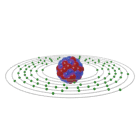
Interactive
Descriptive Numbers
CAS Number
7440-35-9
Mendeleev Number
26
Pettifor Number
42
Space Group Number
194
Glawe Number
39
Mass
Atomic Mass
243 Da
Periodic Position
X Position
10
Y Position
9
Period
7
Group
N/A
Classification
Block
f
Category
Actinides
Goldschmidt
Synthetic
Color
Jmol
#545CF2
Molcas Gv
#545CF2
CPK
#FFFFFF
Atomic Radius
Empirical
175
Rahm
276
Uff
338.1
Alvarez
283
Covalent (Cordero)
180
Covalent (Pyykko)
166
Covalent (Pyykko Double)
135
Metallic
173
Temperature
Melting/Freeze (USE)
1449 °K
Melting/Freeze (WEL)
1449 °K
Melting/Freeze (CRC)
1449 °K
Melting/Freeze (LNG)
1449 °K
Boiling/Density (USE)
2880 °K
Boiling/Density (WEL)
2880 °K
Boiling/Density (CRC)
2284 °K
Boiling/Density (LNG)
2284 °K
Superconducting Point
0.6 °K
Density
STP
12 kg/cm³
Solid (CRC)
12000 kg/cm³
Solid (LNG)
12000 kg/cm³
Heat
Molar Volume
17.63 cm³/mol
Atomic Volume
20.8 cm³
Heat Of Fusion USE
10 kJ/mol
Heat Of Fusion CRC
14.39 kJ/mol
Heat Of Fusion LNG
14.39 kJ/mol
Evaporation USE
238.5 kJ/mol
Evaporation LNG
336 kJ/mol
Evaporation WEL
335 kJ/mol
Molar Heat
62.7 J/molK
Heat Capacity LNG
62.7 J/gK
Adiabatic Index
N/A
Electrical Resistance
293k
689 nΩm
Magnetic Properties
Order
paramanyetic
Susceptibility
5.2e-8 m3/kg
Etymology
Description
Transuranic, radioactive metal element belonging to the actinides class. There are ten known isotopes. Am-243 is the most stable isotope with a half-life of 7.95*10^3 years. This element, discovered by Glenn T. Seaborg and his colleagues in 1945, was obtained by bombarding Uranium-238 with alpha particles.
Origin Of Word
Since the element was first synthesized on this continent, similar to europium, it came from continental America.
Meaning
America
Symbol Origin
place name: continental America
Etymological Description
Since it was discovered in the USA, it was named after the American continent, similar to european harmony. The name of the continent comes from the Italian sailor Amerigo Vespucci.
Discovery & Isolation
Observed/Predicted By
G. T. Seaborg, R. A. James, O. Morgan ve A. Ghiorso
Observed/Discovery Year
1944
Isolated Sample By
Glenn T. Seaborg
Production & Use
Sources
It is obtained by bombarding plutonium with neutrons.
Uses
Americium-241 is used in fire detectors today.
Radioactivity
Half Life
7388 years
Lifetime
1.065×10^4 years
Decay Mode
Alpha Six
Neutron Cross Section
74
Electron Affinity
Electron Affinity (kJ/mol)
9.93
Electron Affinity (pauling)
1.13
Electron Affinity (ghosh)
0.17194
Dipole Polarity
Accepted
131
Uncertainty
25
Lattice
Angles
π/2, π/2, 2 π/3
Electron & Quantum
Oxidation States
2,3,4,5,6,7
Electron Configuration
1s2 2s2 2p6 3s2 3p6 4s2 3d10 4p6 5s2 4d10 5p6 6s2 4f14 5d10 6p6 7s2 5f7
Quantum Number
rainbow/a
Electron Configuration Semantic
[Rn] 5f7 7s2
Shells-0
2
Shells-1
8
Shells-2
18
Shells-3
32
Shells-4
25
Shells-5
8
Shells-6
2
Ionization Energies-0
578
List of Compounds
1-8 of 8 compounds
| Formula | Names |
|---|---|
| Am | americium americium metal |
| AmBr3 | americium(III) bromide |
| AmCl3 | americium(III) chloride |
| AmF3 | americium(III) fluoride |
| AmF4 | americium(IV) fluoride |
| AmI3 | americium(III) iodide |
| AmO2 | americium(IV) oxide |
| Am2O3 | americium(III) oxide |