77
Ir
Iridium
192.2173
Basic Information
Bohr Model
Descriptive Numbers
Mass
Periodic Position
Classification
Abundance
Color
Atomic Radius
Temperature
Density
Heat
Speed of Sound
Electrical Resistance
Magnetic Properties
Elasticity
Hardness
Etymology
Discovery & Isolation
Production & Use
Radioactivity
Electron Affinity
Dipole Polarity
Lattice
Electron & Quantum
List of Compounds
Basic Information

Bohr Model
Static
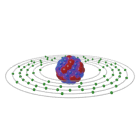
Interactive
Descriptive Numbers
CAS Number
7439-88-5
CID Number
CID23924
DOT Number
3089
Mendeleev Number
65
Pettifor Number
65
Space Group Number
225
Glawe Number
62
Mass
Atomic Mass
192.2173 Da
Uncertainty
0.003
Periodic Position
X Position
9
Y Position
6
Period
6
Group
9
Classification
Block
d
Category
Transition Metal
Geochemical
I am Metal
Goldschmidt
Siderophile
Electrical Type
Conductive
Abundance
Sun
6e-7 mole ratio to silicon
Earth Crust
1e-9 g
Solar System
6.6e-7 mole ratio to silicon
Meteorites
0.000054 %
Color
Jmol
#175487
Molcas Gv
#175487
CPK
#FF1493
Atomic Radius
Empirical
135
Calculated
180
Batsanov
200
Rahm
240
Uff
284
Mm3
236
Alvarez
241
Covalent (Single Bound)
137
Covalent (Triple Bound)
107
Covalent (Cordero)
141
Covalent (Pyykko)
122
Covalent (Pyykko Double)
115
Covalent (Pyykko Triple)
107
Mendeleev
127
C12
136
Metallic
135.5
Temperature
Melting/Freeze (USE)
2719 °K
Melting/Freeze (WEL)
2739 °K
Melting/Freeze (CRC)
2719 °K
Melting/Freeze (LNG)
2720 °K
Boiling/Density (USE)
4403 °K
Boiling/Density (WEL)
4701 °K
Boiling/Density (CRC)
4701 °K
Boiling/Density (LNG)
2823 °K
Boiling/Density (Zhang)
4403 °K
Superconducting Point
0.11 °K
Density
STP
22.56 kg/cm³
Solid (WEL)
22650 kg/cm³
Solid (CRC)
22500 kg/cm³
Solid (LNG)
22650 kg/cm³
Liquid (CR2)
19000 kg/cm³
Heat
Molar Volume
8.52 cm³/mol
Atomic Volume
8.54 cm³
Heat Of Fusion USE
27.61 kJ/mol
Heat Of Fusion CRC
41.12 kJ/mol
Heat Of Fusion LNG
41.12 kJ/mol
Heat Of Fusion WEL
26 kJ/mol
Evaporation USE
604 kJ/mol
Evaporation LNG
231.8 kJ/mol
Evaporation WEL
560 kJ/mol
Evaporation Zhang
564 kJ/mol
Molar Heat
25.1 J/molK
Heat Capacity USE
0.133 J/gK
Heat Capacity CRC
25.1 J/gK
Heat Capacity LNG
25.06 J/gK
Heat Capacity WEL
25.1 J/gK
Thermal Conductivity
147 W/m*K
Thermal Expansion
0.0000064 1/K
Adiabatic Index
N/A
Speed of Sound
Extensional
4825 m/s
Electrical Resistance
273k
47 nΩm
293k
47.1 nΩm
Magnetic Properties
Order
paramanyetic
Susceptibility
1.7e-9 m3/kg
Elasticity
Shear Modulus
210 GPa
Bulk Modulus
320 GPa
Poisson Ratio
0.26 ν
Youngs Modulus
528 GPa
Hardness
Mohs
6.5
Brinell
1670
Vickers
1760–2200
Etymology
Description
It is a silvery transition metal that is quite hard and brittle. It has a yellowish tone color. Iridium salts are extremely colorful. It is the metal known to be the most resistant to corrosion as it is not attacked by any acids, but it is affected by molten salts. Iridium has two natural isotopes and four radioisotopes, the most stable of which is Ir-192 with a half-life of 73.83 days. While other radioisotopes decay to osmium, Ir-192 decays to platinum. Iridium is used in electrical contacts, high-temperature devices, and as a hardening agent for platinum. It was discovered in England by Smithson Tennant in 1803. Its name comes from the Greek word iris, meaning rainbow. Because iridium is relatively inert, it is generally not poisonous, but it should be noted that iridium compounds are extremely toxic.
Language Of Origin
Greek via Latin
Origin Of Word
From Iris, the rainbow goddess in Greek mythology
Meaning
rainbow, pertaining to rainbows
Symbol Origin
descriptive (color)
Etymological Description
It comes from the Latin word iris, meaning "rainbow", "iris flower", "eye iris". Salts of the element are highly colored. The word is actually the name of Iris, the rainbow goddess and messenger of the gods in Greek mythology.
Discovery & Isolation
Observed/Predicted By
S. Tennant
Observed/Discovery Year
1803
Discovery Location


Isolated Sample By
S. Tennant
Isolated Sample Year
1803
Production & Use
Sources
It is found in gravel deposits along with platinum.
Uses
It is used together with osmium in fountain pen nibs, crucibles and special containers. In addition to the alloys required in standard weights and sizes, it is also used in heat-resistant alloys. It is also used as a hardening agent for platinum.
Radioactivity
Half Life
Stable
Lifetime
Stable
Neutron Mass Absorption
0.08
Neutron Cross Section
425
Electron Affinity
Electron Affinity (eV)
1.5638
Electron Affinity (kJ/mol)
150.94
Electron Affinity (pauling)
2.2
Electron Affinity (allen)
9.96
Electron Affinity (ghosh)
0.25106
Dipole Polarity
Accepted
54
Uncertainty
7
C6 GB
522
Lattice
Constant Internal Default Radius
3.84
Strucutre
FCC
Angles
p/2, p/2, p/2
Electron & Quantum
Oxidation States
−3,−1,0,1,2,3,4,5,6,7,8
Electron Configuration
1s2 2s2 2p6 3s2 3p6 4s2 3d10 4p6 5s2 4d10 5p6 6s2 4f14 5d7
Quantum Number
4F9/2
Electron Configuration Semantic
[Car] 4f14 5d7 6s2
Shells-0
2
Shells-1
8
Shells-2
18
Shells-3
32
Shells-4
15
Shells-5
2
Ionization Energies-0
880
Ionization Energies-1
1600
List of Compounds
1-10 of 44 compounds
| Formula | Names |
|---|---|
| Ir | iridium iridium metal |
| Br3Ir | iridium(III) bromide |
| IrCl3 | iridium(III) chloride iridium chlorideiridium trichloride trichloroiridium |
| Cl4Ir | iridium(IV) chloride |
| IrF3 | iridium(III) fluoride |
| IrF6 | iridium(VI) fluoride |
| IrI3 | iridium(III) iodide |
| IrO2 | iridium(IV) oxide diketoiridium dioxoiridium iridium dioxide iridium oxide |
| IrS2 | iridium(IV) sulfide |
| Ir2O3 | iridium(III) oxide |