Basic Information
Name
Neptunium
Atomic Number
93
Appearance
Silvery metallic
Phase At STP
Solid
Spectrum Image

Source
WikipediaBohr Model
Static
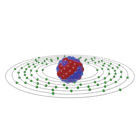
Interactive
Descriptive Numbers
CAS Number
7439-99-8
Mendeleev Number
22
Pettifor Number
44
Space Group Number
62
Glawe Number
37
Mass
Atomic Mass
237 Da
Periodic Position
X Position
8
Y Position
9
Period
7
Group
N/A
Classification
Block
f
Category
Actinides
Goldschmidt
Synthetic
Electrical Type
Conductive
Color
Jmol
#0080FF
Molcas Gv
#0080FF
CPK
#FFFFFF
Atomic Radius
Empirical
175
Rahm
281
Uff
342.4
Mm3
252
Alvarez
282
Covalent (Triple Bound)
116
Covalent (Cordero)
190
Covalent (Pyykko)
171
Covalent (Pyykko Double)
136
Covalent (Pyykko Triple)
116
Metallic
155
Temperature
Melting/Freeze (USE)
912 °K
Melting/Freeze (WEL)
910 °K
Melting/Freeze (CRC)
917 °K
Melting/Freeze (LNG)
917 °K
Boiling/Density (USE)
4447 °K
Boiling/Density (WEL)
4273 °K
Boiling/Density (LNG)
4173 °K
Density
STP
20.45 kg/cm³
Solid (WEL)
20450 kg/cm³
Solid (CRC)
20200 kg/cm³
Solid (LNG)
20200 kg/cm³
Heat
Molar Volume
11.59 cm³/mol
Atomic Volume
21.1 cm³
Heat Of Fusion USE
9.6 kJ/mol
Heat Of Fusion CRC
3.2 kJ/mol
Heat Of Fusion LNG
3.2 kJ/mol
Heat Of Fusion WEL
10 kJ/mol
Evaporation USE
336 kJ/mol
Evaporation LNG
481 kJ/mol
Evaporation WEL
470 kJ/mol
Molar Heat
29.46 J/molK
Heat Capacity LNG
29.46 J/gK
Adiabatic Index
N/A
Electrical Resistance
293k
1220 nΩm
Etymology
Description
It is a transuranic radioactive element found in the actinides class. Its most stable isotope, Np-237, has a half-life of 2.2*10^6 years and is a byproduct of nuclear reactors. Other known isotopes have mass numbers between 229-236 and 238-241. Np-236 has a half-life of 5*10^3 years. It was first published in 1940 by Edwin M. McMillan and P.H. It was obtained by Abelson.
Language Of Origin
Latin
Origin Of Word
The eighth planet in the solar system, from Neptune
Meaning
Neptune
Symbol Origin
astrological, mythological
Etymological Description
It is named after the planet Neptune. The planet is named after Neptune, the god of oceans in Roman mythology.
Discovery & Isolation
Observed/Predicted By
E.M. McMillan ve H. Abelson
Observed/Discovery Year
1940
Isolated Sample By
Edwin McMillan
Production & Use
Sources
It is obtained by bombarding uranium with slow neutrons.
Uses
It has no significant commercial use.
Radioactivity
Half Life
2.1455×10^6 years
Lifetime
3.0952×10^6 years
Decay Mode
Alpha Six
Neutron Cross Section
180
Electron Affinity
Electron Affinity (kJ/mol)
45.85
Electron Affinity (pauling)
1.36
Electron Affinity (ghosh)
0.14265
Dipole Polarity
Accepted
151
Uncertainty
20
Lattice
Constant Internal Default Radius
4.72
Strucutre
ORC
Angles
p/2, p/2, p/2
Electron & Quantum
Oxidation States
2,3,4,5,6,7
Electron Configuration
1s2 2s2 2p6 3s2 3p6 4s2 3d10 4p6 5s2 4d10 5p6 6s2 4f14 5d10 6p6 7s2 5f4 6d1
Quantum Number
6L11/2
Electron Configuration Semantic
[Rn] 5f4 6d1 7s2
Shells-0
2
Shells-1
8
Shells-2
18
Shells-3
32
Shells-4
22
Shells-5
9
Shells-6
2
Ionization Energies-0
604.5