91
Pa
Protactinium
231.035882
Basic Information
Bohr Model
Descriptive Numbers
Mass
Periodic Position
Classification
Abundance
Color
Atomic Radius
Temperature
Density
Heat
Electrical Resistance
Magnetic Properties
Etymology
Discovery & Isolation
Production & Use
Radioactivity
Electron Affinity
Dipole Polarity
Lattice
Electron & Quantum
List of Compounds
Basic Information
Name
Protactinium
Atomic Number
91
Appearance
Bright, silvery metallic shine
Phase At STP
Solid
Spectrum Image

Source
WikipediaBohr Model
Static
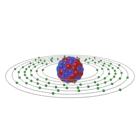
Interactive
Descriptive Numbers
CAS Number
7440-13-3
Mendeleev Number
18
Pettifor Number
46
Space Group Number
139
Glawe Number
35
Mass
Atomic Mass
231.035882 Da
Uncertainty
0.00002
Periodic Position
X Position
6
Y Position
9
Period
7
Group
N/A
Classification
Block
f
Category
Actinides
Geochemical
U/Th decay series
Goldschmidt
Lithophilic
Electrical Type
Conductive
Abundance
Seawater
5e-17 kg/L
Earth Crust
1.4e-12 g
Meteorites
N/A %
Color
Jmol
#00A1FF
Molcas Gv
#00A1FF
CPK
#FFFFFF
Atomic Radius
Empirical
180
Rahm
285
Uff
342.4
Mm3
264
Alvarez
288
Covalent (Triple Bound)
129
Covalent (Cordero)
200
Covalent (Pyykko)
169
Covalent (Pyykko Double)
138
Covalent (Pyykko Triple)
129
Metallic
163
Temperature
Melting/Freeze (USE)
1841 °K
Melting/Freeze (WEL)
1841 °K
Melting/Freeze (CRC)
1845 °K
Boiling/Density (USE)
4300 °K
Superconducting Point
1.4 °K
Density
STP
15.37 kg/cm³
Solid (WEL)
15370 kg/cm³
Solid (CRC)
15400 kg/cm³
Heat
Molar Volume
15.18 cm³/mol
Atomic Volume
15 cm³
Heat Of Fusion USE
16.7 kJ/mol
Heat Of Fusion CRC
12.34 kJ/mol
Heat Of Fusion LNG
12.34 kJ/mol
Heat Of Fusion WEL
15 kJ/mol
Evaporation USE
481.2 kJ/mol
Evaporation WEL
400 kJ/mol
Heat Capacity USE
0.121 J/gK
Adiabatic Index
N/A
Electrical Resistance
273k
177 nΩm
293k
1910 nΩm
Magnetic Properties
Order
paramanyetic
Susceptibility
3.3e-8 m3/kg
Etymology
Description
Radioactive metal element in the actinides class. Its most stable isotope, Pa-231, has a half-life of 2.43*10^4 years. There are at least ten other isotopes known. It has no known use. It was discovered by Lisa Meitner and Otto Hahn in 1917.
Language Of Origin
Greek
Origin Of Word
It is a combination of protos, meaning "first" in Greek, and actium, obtained by the radioactive decay of protactinium.
Meaning
first ray element
Symbol Origin
descriptive (?)
Etymological Description
The Greek prefix proto, meaning "first", is derived from its ancient name protoactinium, which is formed by combining the Latin suffix -ium, aktís, meaning "ray" (possessive: aktínos).
Discovery & Isolation
Observed/Predicted By
O. H. Göhring and K. Fajans
Observed/Discovery Year
1913
Discovery Location


Isolated Sample By
A. von Grosse
Isolated Sample Year
1927
Named By
Otto Hahn
Production & Use
Sources
It is not found in nature. It is found in fission products of uranium, thorium and plutonium.
Uses
It has no significant commercial use.
Radioactivity
Half Life
32788 years
Lifetime
47279 years
Decay Mode
Alpha Six
Neutron Cross Section
500
Electron Affinity
Electron Affinity (kJ/mol)
53.03
Electron Affinity (pauling)
1.5
Electron Affinity (ghosh)
0.12149
Dipole Polarity
Accepted
154
Uncertainty
20
Lattice
Constant Internal Default Radius
3.92
Strucutre
TET
Angles
p/2, p/2, p/2
Electron & Quantum
Oxidation States
3,4,5
Electron Configuration
1s2 2s2 2p6 3s2 3p6 4s2 3d10 4p6 5s2 4d10 5p6 6s2 4f14 5d10 6p6 7s2 5f2 6d1
Quantum Number
4K11/2
Electron Configuration Semantic
[Rn] 5f2 6d1 7s2
Shells-0
2
Shells-1
8
Shells-2
18
Shells-3
32
Shells-4
20
Shells-5
9
Shells-6
2
Ionization Energies-0
568