Basic Information
Name
Radon
Atomic Number
86
Gas Phase
Monatomic
Appearance
Colorless gas sometimes glows green or red in discharge tubes
Phase At STP
Gas
Spectrum Image

Source
WikipediaBohr Model
Static
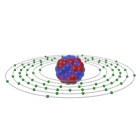
Interactive
Descriptive Numbers
CAS Number
10043-92-2
CID Number
CID24857
DOT Number
2912
RTECS Number
RTECSVE3750000
Mendeleev Number
117
Pettifor Number
6
Eu Number
Ya'a-146-0
Glawe Number
6
Mass
Atomic Mass
222 Da
Periodic Position
X Position
18
Y Position
6
Period
6
Group
18
Classification
Block
p
Category
Noble Gas
Geochemical
U/Th decay series
Goldschmidt
Synthetic
Abundance
Seawater
6e-22 kg/L
Earth Crust
4e-19 g
Meteorites
N/A %
Color
Jmol
#428296
Molcas Gv
#428296
CPK
#FFFFFF
Atomic Radius
Calculated
120
Van Der Waals
220
Rahm
243
Uff
476.5
Mm3
243
Alvarez
240
Truhlar
220
Covalent (Single Bound)
145
Covalent (Triple Bound)
133
Covalent (Cordero)
150
Covalent (Pyykko)
142
Covalent (Pyykko Double)
145
Covalent (Pyykko Triple)
133
Temperature
Melting/Freeze (USE)
202 °K
Melting/Freeze (WEL)
202 °K
Melting/Freeze (CRC)
202 °K
Melting/Freeze (LNG)
202 °K
Boiling/Density (USE)
211.5 °K
Boiling/Density (WEL)
211.3 °K
Boiling/Density (CRC)
211.3 °K
Boiling/Density (LNG)
211 °K
Critical Temperature
377 °K
Critical Pressure
6.28 MPa
Density
STP
9.73 kg/cm³
Gas
9.73 kg/cm³
Heat
Molar Volume
50.5 cm³/mol
Heat Of Fusion LNG
3.247 kJ/mol
Heat Of Fusion WEL
3 kJ/mol
Evaporation USE
18.1 kJ/mol
Evaporation LNG
102.91 kJ/mol
Heat Capacity USE
0.094 J/gK
Heat Capacity CRC
20.786 J/gK
Heat Capacity LNG
20.79 J/gK
Heat Capacity WEL
20.79 J/gK
Thermal Conductivity
0.0036 W/m*K
Adiabatic Index
42799
Etymology
Description
It is colorless, radioactive, gaseous and in the noble gas class. Among the 20 known isotopes, the most stable is Rn-222, with a half-life of 3.8 days. It is formed by the radioactive decay of radium-226. Radon itself decays to polonium. It is used in radiotherapy. Although radon fluoride compound has been synthesized with it, it is inert as a noble gas. It was first isolated by Ramsey and Gray in 1908.
Language Of Origin
Latin via German and English
Origin Of Word
Since it was first found during the radioactive decay of radium, it
Etymological Description
The element is a shortened form of the English expression (radium emanation) meaning "ejection of radium" as it appears in the radioactive decay of radium. Another name that was proposed and later rejected because of its radioluminescence was Niton (Nt), which comes from the Latin word nitens meaning "shining".
Discovery & Isolation
Observed/Predicted By
E. Rutherford ve R. B. Owens
Observed/Discovery Year
1899
Discovery Location

Isolated Sample By
W. Ramsay ve R. Whytlaw-Gray
Isolated Sample Year
1910
Production & Use
Sources
It is formed as a result of the decay of radium on the Earth's surface.
Uses
It is used in the treatment of some types of cancer.
Radioactivity
Half Life
3.823495 days
Lifetime
5.516088 days
Decay Mode
Alpha Six
Neutron Cross Section
0.7
Electron Affinity
Electron Affinity (kJ/mol)
-68
Electron Affinity (pauling)
2.2
Electron Affinity (allen)
15.4
Electron Affinity (ghosh)
0.195772
Dipole Polarity
Accepted
35
Uncertainty
2
C6 GB
408
Lattice
Strucutre
FCC
Electron & Quantum
Oxidation States
2,6
Electron Configuration
1s2 2s2 2p6 3s2 3p6 4s2 3d10 4p6 5s2 4d10 5p6 6s2 4f14 5d10 6p6
Quantum Number
1S0
Electron Configuration Semantic
[Rook] 4f14 5d10 6s2 6p6
Shells-0
2
Shells-1
8
Shells-2
18
Shells-3
32
Shells-4
18
Shells-5
8
Ionization Energies-0
1037