47
Ag
Silver
107.86822
Basic Information
Bohr Model
Descriptive Numbers
Mass
Periodic Position
Classification
Abundance
Color
Atomic Radius
Temperature
Density
Heat
Speed of Sound
Electrical Resistance
Magnetic Properties
Elasticity
Hardness
Etymology
Discovery & Isolation
Production & Use
Radioactivity
Electron Affinity
Dipole Polarity
Lattice
Electron & Quantum
List of Compounds
Basic Information
Name
Silver
Alternative Name
Silver
Atomic Number
47
Appearance
Shiny white metal
Phase At STP
Solid
Spectrum Image

Source
WikipediaBohr Model
Static
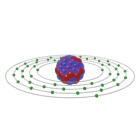
Interactive
Descriptive Numbers
CAS Number
7440-22-4
CID Number
CID23954
RTECS Number
RTECSVW3500000
Mendeleev Number
72
Pettifor Number
71
Space Group Number
225
Glawe Number
67
Mass
Atomic Mass
107.86822 Da
Uncertainty
0.0002
Periodic Position
X Position
11
Y Position
5
Period
5
Group
11
Classification
Block
d
Category
Transition Metal
Goldschmidt
Chalcophilic
Electrical Type
Conductive
Abundance
Urban Soil
0.0004 mg/kg
Seawater
4e-11 kg/L
Sun
2e-7 mole ratio to silicon
Earth Crust
7.5e-8 g
Solar System
4.9e-7 mole ratio to silicon
Meteorites
0.000014 %
Color
Jmol
#C0C0C0
Molcas Gv
#C0C0C0
CPK
#808090
Atomic Radius
Empirical
160
Calculated
165
Van Der Waals
172
Batsanov
210
Rahm
225
Uff
314.8
Mm3
243
Alvarez
253
Bragg
177
Covalent (Single Bound)
153
Covalent (Triple Bound)
137
Covalent (Cordero)
145
Covalent (Pyykko)
128
Covalent (Pyykko Double)
139
Covalent (Pyykko Triple)
137
Mendeleev
134
C12
144
Metallic
144
Temperature
Melting/Freeze (USE)
1234.93 °K
Melting/Freeze (WEL)
1234.93 °K
Melting/Freeze (CRC)
1234.78 °K
Melting/Freeze (LNG)
1234.78 °K
Boiling/Density (USE)
2435 °K
Boiling/Density (WEL)
2435 °K
Boiling/Density (CRC)
2435 °K
Boiling/Density (LNG)
2437 °K
Boiling/Density (Zhang)
2483 °K
Density
STP
10.49 kg/cm³
Solid (WEL)
10490 kg/cm³
Solid (CRC)
10500 kg/cm³
Solid (LNG)
10490 kg/cm³
Liquid (CR2)
9320 kg/cm³
Heat
Molar Volume
10.27 cm³/mol
Atomic Volume
10.3 cm³
Heat Of Fusion USE
11.95 kJ/mol
Heat Of Fusion CRC
11.28 kJ/mol
Heat Of Fusion LNG
11.95 kJ/mol
Heat Of Fusion WEL
11.3 kJ/mol
Evaporation USE
254.1 kJ/mol
Evaporation LNG
258 kJ/mol
Evaporation WEL
255 kJ/mol
Evaporation Zhang
254 kJ/mol
Molar Heat
25.35 J/molK
Heat Capacity USE
0.237 J/gK
Heat Capacity CRC
25.35 J/gK
Heat Capacity LNG
25.4 J/gK
Heat Capacity WEL
25.4 J/gK
Thermal Conductivity
429 W/m*K
Thermal Expansion
0.0000189 1/K
Adiabatic Index
N/A
Speed of Sound
Longitudinal
3650 m/s
Transversal
1610 m/s
Extensional
2680 m/s
Electrical Resistance
80k
2.89 nΩm
273k
14.67 nΩm
293k
15.87 nΩm
298k
16.17 nΩm
300k
16.29 nΩm
500k
28.7 nΩm
Magnetic Properties
Order
Diamagnetic
Susceptibility
-2.3e-9 m3/kg
Elasticity
Shear Modulus
30 GPa
Bulk Modulus
100 GPa
Poisson Ratio
0.37 ν
Youngs Modulus
83 GPa
Hardness
Mohs
2.5
Brinell
245–250
Vickers
250
Etymology
Description
It is a white, shiny, soft transition metal. It is found both in its elemental form and in minerals. It is found in many products such as jewelry and dinnerware.
Language Of Origin
Akkadian through Old and Medieval English
Origin Of Word
From the English word (argentum in Latin)
Meaning
purify, melt
Symbol Origin
Latin argentum
Etymological Description
The Old English version of Proto-Germanic *silubra- comes from the word seolfor. It is similar to the Old High German word silabar and has cognates in Baltic-Slavic languages. For example, sĭrebro in Church Slavonic, sidabras in Lithuanian, sirablan in Old Prussian. These probably come from the Akkadian word sarpu, meaning "purified silver", and sarapu, meaning "to purify". Apart from this, they may also have come from one of the Proto-Indo-European languages (cf. Basque zilar). The symbol for the element, Ag, comes from Latin argentum, derived from Proto-Indo-European *arg-ent-.
Discovery & Isolation
Observed/Predicted By
Asia Minor (Anatolia)
Observed/Discovery Year
before 5000 BC
Isolated Sample Year
ca. 4000 BC
Production & Use
Sources
It is found in argentite (AgS), light and dark pyrargyrite (Ag3AsS3) and friable silver ores.
Uses
It is used in jewelry alloys and compounds required in photography. It is also a good conductor, but expensive.
Radioactivity
Half Life
Stable
Lifetime
Stable
Neutron Mass Absorption
0.02
Neutron Cross Section
63.6
Electron Affinity
Electron Affinity (eV)
1.302
Electron Affinity (kJ/mol)
125.862
Electron Affinity (pauling)
1.93
Electron Affinity (allen)
11.05
Electron Affinity (ghosh)
0.1472165
Dipole Polarity
Accepted
55
Uncertainty
8
C6 GB
341
Lattice
Constant Internal Default Radius
4.09
Constant
408.53, 408.53, 408.53
Strucutre
FCC
Angles
p/2, p/2, p/2
Electron & Quantum
Oxidation States
−2,−1,1,2,3
Electron Configuration
1s2 2s2 2p6 3s2 3p6 4s2 3d10 4p6 5s1 4d10
Quantum Number
2S1/2
Electron Configuration Semantic
[Kr] 4d10 5s1
Shells-0
2
Shells-1
8
Shells-2
18
Shells-3
18
Shells-4
1
Ionization Energies-0
731
Ionization Energies-1
2070
Ionization Energies-2
3361
List of Compounds
1-10 of 75 compounds
| Formula | Names |
|---|---|
| Ag | silver argentum silver metal |
| AgBr | silver bromide bromosilver silver (1) bromide silver brohide |
| AgCl | silver chloride chlorosilver silver(I) chloride silver monochloride |
| AgF | silver fluoride argentous fluoride fluorosilver silver(I) fluoride silver monofluoride |
| AgF2 | silver difluoride difluorosilver silver(2+) fluoride silver(II) difluoride silver(II) fluoride |
| AgI | silver(I) iodide colloidal silver iodide neosiluol silver iodide |
| AgN3 | silver azide silver(1+) azide silver monoazide |
| AgO | silver(II) oxide disilver oxide divasil silver oxidesilver oxideketosilver oxosilver |
| Ag2C2 | silver(I) acetylide |
| Ag2F | silver subfluoride |