Basic Information
Name
Curium
Atomic Number
96
Appearance
Silvery metallic, glows purple in the dark
Phase At STP
Solid
Spectrum Image

Source
WikipediaBohr Model
Static
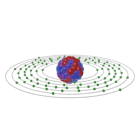
Interactive
Descriptive Numbers
CAS Number
7440-51-9
Mendeleev Number
28
Pettifor Number
41
Space Group Number
194
Glawe Number
40
Mass
Atomic Mass
247 Da
Periodic Position
X Position
11
Y Position
9
Period
7
Group
N/A
Classification
Block
f
Category
Actinides
Goldschmidt
Synthetic
Color
Jmol
#785CE3
Molcas Gv
#785CE3
CPK
#FFFFFF
Atomic Radius
Empirical
176
Rahm
276
Uff
332.6
Alvarez
305
Covalent (Cordero)
169
Covalent (Pyykko)
166
Covalent (Pyykko Double)
136
Metallic
174
Temperature
Melting/Freeze (USE)
1613 °K
Melting/Freeze (WEL)
1613 °K
Melting/Freeze (CRC)
1618 °K
Melting/Freeze (LNG)
1613 °K
Boiling/Density (USE)
3383 °K
Boiling/Density (WEL)
3383 °K
Boiling/Density (CRC)
3373 °K
Boiling/Density (LNG)
3383 °K
Density
STP
13.51 kg/cm³
Solid (WEL)
13510 kg/cm³
Solid (CRC)
13510 kg/cm³
Solid (LNG)
13510 kg/cm³
Heat
Molar Volume
18.05 cm³/mol
Atomic Volume
18.28 cm³
Adiabatic Index
N/A
Electrical Resistance
293k
1250 nΩm
Etymology
Description
It is a transuranic, radioactive metal element. It is found in the actinides class. There are nine known isotopes. Cm-247 has a half-life of 1.64*10^7 years. It was first discovered by Glenn T. Seaborg and his colleagues in 1944, and was discovered by L.B. Seaborg in 1947. It was obtained by Werner and I. Perlman by bombarding americium-241 with neutrons. It was named after Marie Curie.
Origin Of Word
From physicist Pierre Curie, chemist and physicist Marie Curie. As with gadolinium, it is named after great scientists.
Meaning
Marie ve Pierre Curie
Symbol Origin
surname, eponym: Pierre and Marie Curie + -um suffix
Etymological Description
This name was given in honor of Marie and Pierre Curie, who discovered radium and conducted radioactivity research.
Discovery & Isolation
Observed/Predicted By
Glenn T. Seaborg, Ralph A. James ve Albert Ghiorso
Observed/Discovery Year
1944
Isolated Sample By
Glenn T. Seaborg
Production & Use
Sources
It is obtained by bombarding plutonium with helium ions. It is radioactive enough to glow in the dark.
Uses
It has no significant commercial use.
Radioactivity
Half Life
1.56×10^7 years
Lifetime
2.25×10^7 years
Decay Mode
Alpha Six
Neutron Cross Section
60
Electron Affinity
Electron Affinity (kJ/mol)
27.17
Electron Affinity (pauling)
1.28
Electron Affinity (ghosh)
0.17439
Dipole Polarity
Accepted
144
Uncertainty
25
Lattice
Angles
π/2, π/2, 2 π/3
Electron & Quantum
Oxidation States
3,4,5,6
Electron Configuration
1s2 2s2 2p6 3s2 3p6 4s2 3d10 4p6 5s2 4d10 5p6 6s2 4f14 5d10 6p6 7s2 5f7 6d1
Quantum Number
sincerity
Electron Configuration Semantic
[Rn] 5f7 6d1 7s2
Shells-0
2
Shells-1
8
Shells-2
18
Shells-3
32
Shells-4
25
Shells-5
9
Shells-6
2
Ionization Energies-0
581