Basic Information
Name
Einsteinium
Atomic Number
99
Appearance
Silver colored
Phase At STP
Solid
Spectrum Image

Source
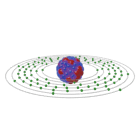
WikipediaBohr Model
Static
Interactive
Descriptive Numbers
CAS Number
7429-92-7
Mendeleev Number
34
Pettifor Number
38
Glawe Number
43
Mass
Atomic Mass
252 Da
Periodic Position
X Position
14
Y Position
9
Period
7
Group
N/A
Classification
Block
f
Category
Actinides
Goldschmidt
Synthetic
Color
Jmol
#B31FD4
Molcas Gv
#B31FD4
CPK
#FFFFFF
Atomic Radius
Uff
329.9
Alvarez
270
Covalent (Pyykko)
165
Covalent (Pyykko Double)
140
Metallic
186+/- 2
Temperature
Melting/Freeze (USE)
1133 °K
Melting/Freeze (WEL)
1133 °K
Melting/Freeze (CRC)
1133 °K
Melting/Freeze (LNG)
1133 °K
Boiling/Density (USE)
1269 °K
Density
STP
8.84 kg/cm³
Solid (LNG)
8840 kg/cm³
Heat
Molar Volume
28.52 cm³/mol
Adiabatic Index
N/A
Etymology
Description
Its appearance is unknown, but it is most likely silver or gray in color and metal. It is a transuranic radioactive element belonging to the actinides class. Es-254 has the longest half-life among the 11 known isotopes. It was first found in the debris of the first hydrogen bomb detonated by Albert Ghiorso and his colleagues in 1952. In 1961, the first microgram amounts of Es-232 were isolated. While einsteinium does not occur naturally, it can pose a radiation risk if combined in sufficient quantities.
Language Of Origin
German
Origin Of Word
From physicist Albert Einstein
Meaning
Judeo-German surname meaning a stone
Symbol Origin
surname, eponym
Etymological Description
It is named in honor of Albert Einstein for his work in theoretical physics, including the photoelectric effect.
Discovery & Isolation
Observed/Predicted By
A. Ghiorso et al. (Argonne Laboratory, Los Alamos Laboratory and University of California, Berkeley)
Observed/Discovery Year
1952
Isolated Sample By
Lawrence Berkeley National Laboratory
Isolated Sample Year
1952
Production & Use
Sources
It is made by bombarding uranium with neutrons.
Uses
It has no significant commercial use.
Radioactivity
Half Life
1.2922 years
Lifetime
1,865 years
Decay Mode
Alpha Six
Neutron Cross Section
160
Electron Affinity
Electron Affinity (kJ/mol)
-28.6
Electron Affinity (pauling)
1.3
Electron Affinity (ghosh)
0.21427
Dipole Polarity
Accepted
118
Uncertainty
20
Electron & Quantum
Oxidation States
2,3,4
Electron Configuration
1s2 2s2 2p6 3s2 3p6 4s2 3d10 4p6 5s2 4d10 5p6 6s2 4f14 5d10 6p6 7s2 5f11
Quantum Number
5I15/2
Electron Configuration Semantic
[Rn] 5f11 7s2
Shells-0
2
Shells-1
8
Shells-2
18
Shells-3
32
Shells-4
29
Shells-5
8
Shells-6
2
Ionization Energies-0
619