79
Au
Gold
196.9665695
Basic Information
Bohr Model
Descriptive Numbers
Mass
Periodic Position
Classification
Abundance
Color
Atomic Radius
Temperature
Density
Heat
Speed of Sound
Electrical Resistance
Magnetic Properties
Elasticity
Hardness
Etymology
Discovery & Isolation
Production & Use
Radioactivity
Electron Affinity
Dipole Polarity
Lattice
Electron & Quantum
List of Compounds
Basic Information
Name
Gold
Alternative Name
Aurum
Atomic Number
79
Appearance
Metallic yellow
Phase At STP
Solid
Spectrum Image

Source
WikipediaBohr Model
Static
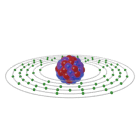
Interactive
Descriptive Numbers
CAS Number
7440-57-5
CID Number
CID23985
RTECS Number
RTECSMD5070000
Mendeleev Number
73
Pettifor Number
70
Space Group Number
225
Glawe Number
66
Mass
Atomic Mass
196.9665695 Da
Uncertainty
0.000005
Periodic Position
X Position
11
Y Position
6
Period
6
Group
11
Classification
Block
d
Category
Transition Metal
Geochemical
I am metal
Goldschmidt
Siderophile
Electrical Type
Conductive
Abundance
Seawater
4e-12 kg/L
Sun
3e-7 mole ratio to silicon
Earth Crust
4e-9 g
Solar System
1.9e-7 mole ratio to silicon
Meteorites
0.000017 %
Color
Jmol
#FFD123
Molcas Gv
#FFD123
CPK
#DAA520
Atomic Radius
Empirical
135
Calculated
174
Van Der Waals
166
Batsanov
210
Rahm
226
Uff
329.3
Mm3
243
Alvarez
232
Covalent (Single Bound)
144
Covalent (Triple Bound)
123
Covalent (Cordero)
136
Covalent (Pyykko)
124
Covalent (Pyykko Double)
121
Covalent (Pyykko Triple)
123
Mendeleev
134
C12
144
Metallic
144
Temperature
Melting/Freeze (USE)
1337.33 °K
Melting/Freeze (WEL)
1337.33 °K
Melting/Freeze (CRC)
1337.18 °K
Melting/Freeze (LNG)
1337.18 °K
Boiling/Density (USE)
3243 °K
Boiling/Density (WEL)
3129 °K
Boiling/Density (CRC)
3129 °K
Boiling/Density (LNG)
3129 °K
Boiling/Density (Zhang)
3243 °K
Density
STP
19.3 kg/cm³
Solid (WEL)
19300 kg/cm³
Solid (CRC)
19300 kg/cm³
Solid (LNG)
19300 kg/cm³
Liquid (CR2)
17310 kg/cm³
Heat
Molar Volume
10.21 cm³/mol
Atomic Volume
10.2 cm³
Heat Of Fusion USE
12.68 kJ/mol
Heat Of Fusion CRC
12.72 kJ/mol
Heat Of Fusion LNG
12.55 kJ/mol
Heat Of Fusion WEL
12.5 kJ/mol
Evaporation USE
340 kJ/mol
Evaporation CRC
324 kJ/mol
Evaporation LNG
324 kJ/mol
Evaporation WEL
330 kJ/mol
Evaporation Zhang
342 kJ/mol
Molar Heat
25.418 J/molK
Heat Capacity USE
0.129 J/gK
Heat Capacity CRC
25.418 J/gK
Heat Capacity LNG
25.36 J/gK
Heat Capacity WEL
25.42 J/gK
Thermal Conductivity
318 W/m*K
Thermal Expansion
0.0000142 1/K
Adiabatic Index
N/A
Speed of Sound
Longitudinal
3240 m/s
Transversal
1200 m/s
Extensional
2030 m/s
Electrical Resistance
80k
4.81 nΩm
273k
20.51 nΩm
293k
22.14 nΩm
298k
22.55 nΩm
300k
22.71 nΩm
500k
39.7 nΩm
Magnetic Properties
Order
Diamagnetic
Susceptibility
-1.8e-9 m3/kg
Elasticity
Shear Modulus
27 GPa
Bulk Modulus
180 GPa
Poisson Ratio
0.44 ν
Youngs Modulus
78 GPa
Hardness
Mohs
2.5
Brinell
188–245
Vickers
188–216
Etymology
Description
It is the most ductile and malleable metal known. Gold has only one stable isotope and six radioisotopes. Au-195 is the most stable with a half-life of 186 days. It is used in jewelry, dentistry, electronics and as a monetary standard. Au-198 is used in the treatment of cancer and some other health problems. Gold is known to have existed since 2600 BC. Its symbol, Au, comes from the Latin word aurum, meaning gold. Gold itself is not poisonous, but it is known to damage the liver and kidneys to certain extent.
Language Of Origin
Old English via Medieval English
Origin Of Word
From the English word (Latin aurum)
Symbol Origin
descriptive (color): Latin aurum
Etymological Description
From the Old English word "gold" from Proto-Indo-European *ghel-, meaning yellow or "bright". The symbol Au is an abbreviation for the Latin word aurum, meaning "bright dawn".
Discovery & Isolation
Observed/Predicted By
East Mediterranean
Observed/Discovery Year
before 6000 BC
Isolated Sample By
Wadi Qana
Isolated Sample Year
before 4000 BC
Production & Use
Sources
It is found naturally and in veins in the earth along with copper ores.
Uses
It has an extremely malleable structure. It is used in electronics, jewelry and coins. It is a good reflector of infrared radiation, which is why a thin layer of gold is used in the windows of skyscrapers to reduce internal heating by sunlight.
Radioactivity
Half Life
Stable
Lifetime
Stable
Neutron Mass Absorption
0.017
Neutron Cross Section
98.7
Electron Affinity
Electron Affinity (eV)
2.30863
Electron Affinity (kJ/mol)
222.747
Electron Affinity (pauling)
2.54
Electron Affinity (allen)
11.33
Electron Affinity (ghosh)
0.26137
Dipole Polarity
Accepted
36
Uncertainty
3
C6 GB
427
Lattice
Constant Internal Default Radius
4.08
Strucutre
FCC
Angles
p/2, p/2, p/2
Electron & Quantum
Oxidation States
−3,−2,−1,0,1,2,3,5
Electron Configuration
1s2 2s2 2p6 3s2 3p6 4s2 3d10 4p6 5s2 4d10 5p6 6s1 4f14 5d10
Quantum Number
2S1/2
Electron Configuration Semantic
[Rook] 4f14 5d10 6s1
Shells-0
2
Shells-1
8
Shells-2
18
Shells-3
32
Shells-4
18
Shells-5
1
Ionization Energies-0
890.1
Ionization Energies-1
1980
List of Compounds
1-10 of 44 compounds
| Formula | Names |
|---|---|
| Au | goldaurum gold metal |
| AuBr3·xH2O | gold(III) bromide auric bromide gold bromidehydrogen tetrabromoaurate(III) hydrate tribromogold |
| AuCl | gold(I)chloride gold(+1) cation chloride |
| AuCl3 | gold(III)chloride trichlorogold |
| AuF3 | gold(III) fluoride |
| AuI | gold(I) iodide aurous iodide gold iodide iodogold |
| AuI3 | gold(III)iodide gold triiodide |
| Au2O3·xH2O | gold(III) oxide auric oxide gold trioxide keto-(ketoauriooxy)gold oxo-(oxoauriooxy)gold sulfurous acid, ammonium gold salt |
| Au2S3 | gold(III) sulfide auric sulfide digold trisulphide gold(+3) cation trisulfide gold trisulfide |
| Au2Se3 | gold(III) selenide |