2
He
Helium
4.0026022
Basic Information
Name
Helium
Atomic Number
2
Gas Phase
Monatomic
Appearance
Colorless gas glows red-orange when placed in a high-voltage electric field
Refractive Index
1.000035
Phase At STP
Gas
Spectrum Image

Source
WikipediaBohr Model
Static
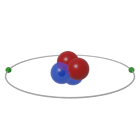
Interactive
Descriptive Numbers
CAS Number
7440-59-7
CID Number
CID23987
DOT Number
1963
RTECS Number
RTECSMH6520000
Mendeleev Number
112
Pettifor Number
1
Space Group Number
225
Glawe Number
1
Mass
Atomic Mass
4.0026022 Da
Uncertainty
0.000002
Periodic Position
X Position
18
Y Position
1
Period
1
Group
18
Classification
Block
s
Category
Noble Gas
Geochemical
Volatile
Goldschmidt
Atmospheric
Abundance
Seawater
7e-12 kg/L
Sun
2,700 mole ratio to silicon
Earth Crust
8e-9 g
Solar System
2,700 mole ratio to silicon
Meteorites
N/A %
Color
Jmol
#D9FFFF
Molcas Gv
#D9FFFF
CPK
#FFC0CB
Atomic Radius
Empirical
120
Calculated
31
Van Der Waals
140
Bonding
140
Rahm
134
Uff
236.2
Mm3
153
Alvarez
143
Covalent (Single Bound)
32
Covalent (Cordero)
28
Covalent (Pyykko)
46
C12
122
Temperature
Melting/Freeze (USE)
0.95 °K
Melting/Freeze (WEL)
0.95 °K
Melting/Freeze (LNG)
0.85 °K
Boiling/Density (USE)
4.222 °K
Boiling/Density (WEL)
4.22 °K
Boiling/Density (CRC)
4.072 °K
Boiling/Density (LNG)
4.065 °K
Boiling/Density (Zhang)
4 °K
Critical Temperature
5.19 °K
Critical Pressure
0.227 MPa
Density
STP
0.1786 kg/cm³
Gas
0.1786 kg/cm³
Heat
Molar Volume
22,413.60 cm³/mol
Atomic Volume
31.8 cm³
Heat Of Fusion LNG
0.0138 kJ/mol
Heat Of Fusion WEL
0.02 kJ/mol
Evaporation USE
0.08 kJ/mol
Evaporation CRC
0.08 kJ/mol
Evaporation LNG
0.0829 kJ/mol
Evaporation WEL
0.083 kJ/mol
Heat Capacity USE
5.188 J/gK
Heat Capacity CRC
20.786 J/gK
Heat Capacity LNG
20.786 J/gK
Heat Capacity WEL
20.786 J/gK
Thermal Conductivity
0.152 W/m*K
Adiabatic Index
42799
Speed of Sound
Fluid
965 m/s
Magnetic Properties
Order
Diamagnetic
Susceptibility
-5.9e-9 m3/kg
Etymology
Description
It is a colorless, odorless, nonmetal element that exists in gaseous form. It belongs to group 18 in the periodic table. It has the lowest boiling point of all the elements and can only solidify if pressure is applied. It is chemically inert and has no known compounds. It was discovered in the solar spectrum by Lockyer in 1868.
Language Of Origin
Greek
Origin Of Word
From the Greek word helios, meaning "sun"
Meaning
sun
Symbol Origin
astrological, mythological
Etymological Description
It derives from the Greek word helios, meaning "sun" or mythological sun god.
Discovery & Isolation
Observed/Predicted By
P. Janssen ve N. Lockyer
Observed/Discovery Year
1868
Discovery Location


Isolated Sample By
W. Ramsay, T. Cleve, ve N. Langlet
Isolated Sample Year
1895
Production & Use
Sources
It is found in natural gas deposits and air (at a rate of 5 ppb). It is constantly lost in space and replenished by radioactive decay (alpha particles).
Uses
It is used in balloons, deep diving and welding. It is also used in research requiring low temperatures.
Radioactivity
Half Life
Stable
Lifetime
Stable
Neutron Mass Absorption
0.00001
Neutron Cross Section
0.01
Electron Affinity
Proton Affinity
177.8
Electron Affinity (eV)
-19.7
Electron Affinity (kJ/mol)
-48
Electron Affinity (allen)
24.59
Electron Affinity (ghosh)
0.442712
Dipole Polarity
Accepted
1.38375
Uncertainty
0.00002
C6 GB
1.47
C6 Coefficient
1.42
Lattice
Constant Internal Default Radius
3.57
Constant
424.2, 424.2, 424.2
Strucutre
HEX
Angles
p/2, p/2, p/2
Electron & Quantum
Electron Configuration
1s2
Quantum Number
1S0
Electron Configuration Semantic
1s2
Shells-0
2
Ionization Energies-0
2372.3
Ionization Energies-1
5250.5