25
Mn
Manganese
54.9380443
Basic Information
Bohr Model
Descriptive Numbers
Mass
Periodic Position
Classification
Abundance
Color
Atomic Radius
Temperature
Density
Heat
Speed of Sound
Electrical Resistance
Magnetic Properties
Elasticity
Hardness
Etymology
Discovery & Isolation
Production & Use
Radioactivity
Electron Affinity
Dipole Polarity
Lattice
Electron & Quantum
List of Compounds
Basic Information
Name
Manganese
Atomic Number
25
Appearance
Silvery metallic
Phase At STP
Solid
Spectrum Image

Source
WikipediaBohr Model
Static
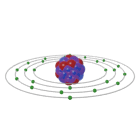
Interactive
Descriptive Numbers
CAS Number
7439-96-5
CID Number
CID23930
DOT Number
3089
Mendeleev Number
55
Pettifor Number
60
Space Group Number
217
Glawe Number
72
Mass
Atomic Mass
54.9380443 Da
Uncertainty
0.000003
Periodic Position
X Position
7
Y Position
4
Period
4
Group
7
Classification
Block
d
Category
Transition Metal
Geochemical
First Series Transition Metal
Goldschmidt
Siderophile
Electrical Type
Conductive
Abundance
Urban Soil
0.729 mg/kg
Seawater
2e-10 kg/L
Sun
0.0069 mole ratio to silicon
Earth Crust
0.00095 g
Solar System
0.0095 mole ratio to silicon
Meteorites
0.27 %
Color
Jmol
#9C7AC7
Molcas Gv
#9C7AC7
CPK
#808090
Atomic Radius
Empirical
140
Calculated
161
Batsanov
205
Rahm
242
Uff
296.1
Mm3
224
Alvarez
245
Bragg
147
Covalent (Single Bound)
139
Covalent (Triple Bound)
103
Covalent (Cordero)
150
Covalent (Pyykko)
119
Covalent (Pyykko Double)
105
Covalent (Pyykko Triple)
103
Mendeleev
118
C12
127
Metallic
127
Temperature
Melting/Freeze (USE)
1519 °K
Melting/Freeze (WEL)
1519 °K
Melting/Freeze (CRC)
1519 °K
Melting/Freeze (LNG)
1517 °K
Boiling/Density (USE)
2334 °K
Boiling/Density (WEL)
2334 °K
Boiling/Density (CRC)
2334 °K
Boiling/Density (LNG)
2368 °K
Boiling/Density (Zhang)
2373 °K
Density
STP
7.21 kg/cm³
Solid (WEL)
7470 kg/cm³
Solid (CRC)
7300 kg/cm³
Solid (LNG)
7210 kg/cm³
Liquid (CR2)
5950 kg/cm³
Heat
Molar Volume
7.35 cm³/mol
Atomic Volume
7.39 cm³
Heat Of Fusion USE
13.4 kJ/mol
Heat Of Fusion CRC
12.91 kJ/mol
Heat Of Fusion LNG
12.9 kJ/mol
Heat Of Fusion WEL
13.2 kJ/mol
Evaporation USE
221 kJ/mol
Evaporation LNG
221 kJ/mol
Evaporation WEL
220 kJ/mol
Evaporation Zhang
225 kJ/mol
Molar Heat
26.32 J/molK
Heat Capacity USE
0.477 J/gK
Heat Capacity CRC
26.32 J/gK
Heat Capacity LNG
26.3 J/gK
Heat Capacity WEL
26.3 J/gK
Thermal Expansion
0.0000217 1/K
Adiabatic Index
N/A
Speed of Sound
Extensional
5150 m/s
Electrical Resistance
80k
1320 nΩm
273k
1430 nΩm
293k
1440 nΩm
298k
1440 nΩm
300k
1440 nΩm
500k
1490 nΩm
Magnetic Properties
Order
paramanyetic
Neel Point
100 Tn
Susceptibility
1.2e-7 m3/kg
Elasticity
Bulk Modulus
120 GPa
Youngs Modulus
198 GPa
Hardness
Mohs
6
Brinell
196
Etymology
Description
It is a gray and brittle transition metal. It is extremely electropositive and can combine with nonmetals when heated. It was discovered by Scheele in 1774.
Language Of Origin
Greek via Latin, Italian and French
Origin Of Word
Changed from the group Magnesia negra (see Magnesium)
Meaning
Magnesia
Symbol Origin
descriptive
Etymological Description
From the Latin word "Magnesia", which eventually entered Greek. Magnesia evolved into the words "mangenese" in Italian and "manganèse" in French.
Discovery & Isolation
Observed/Predicted By
W. Scheele
Observed/Discovery Year
1774
Discovery Location

Isolated Sample By
G. Gahn
Isolated Sample Year
1774
Production & Use
Sources
The most abundant ores are pyrolusite (MnO2), psilomelane [(Ba,H2O)2Mn5O10] and rhodochrosite (MnCO3). The pure metal form is obtained by mixing manganese dioxide (MnO2) with powdered aluminum and firing it in a furnace.
Uses
It is used in steel, batteries and ceramics. Steel in railroad tracks can contain as much as 1.2% manganese. Vitamin B1 is essential for it to be effective.
Radioactivity
Half Life
Stable
Lifetime
Stable
Neutron Mass Absorption
0.0083
Neutron Cross Section
13.3
Electron Affinity
Proton Affinity
797.3
Electron Affinity (kJ/mol)
-50
Electron Affinity (pauling)
1.55
Electron Affinity (allen)
10.34
Electron Affinity (ghosh)
0.1352844
Dipole Polarity
Accepted
68
Uncertainty
9
C6 GB
635
C6 Coefficient
552
Lattice
Constant Internal Default Radius
8.89
Constant
891.25, 891.25, 891.25
Strucutre
CUB
Angles
p/2, p/2, p/2
Electron & Quantum
Oxidation States
−3,−2,−1,0,1,2,3,4,5,6,7
Electron Configuration
1s2 2s2 2p6 3s2 3p6 4s2 3d5
Quantum Number
Tsakh/A
Electron Configuration Semantic
[ar] 3d5 4s2
Shells-0
2
Shells-1
8
Shells-2
13
Shells-3
2
Ionization Energies-0
717.3
Ionization Energies-1
1509
Ionization Energies-2
3248
Ionization Energies-3
4940
Ionization Energies-4
6990
Ionization Energies-5
9220
Ionization Energies-6
11500
Ionization Energies-7
18770
Ionization Energies-8
21400
Ionization Energies-9
23960
Ionization Energies-10
27590
Ionization Energies-11
30330
Ionization Energies-12
33150
Ionization Energies-13
38880
Ionization Energies-14
41987
Ionization Energies-15
109480
Ionization Energies-16
118100
Ionization Energies-17
127100
Ionization Energies-18
138600
Ionization Energies-19
148500
Ionization Energies-20
158600
Ionization Energies-21
172500
Ionization Energies-22
181380
Ionization Energies-23
785450
Ionization Energies-24
827067
List of Compounds
1-10 of 89 compounds
| Formula | Names |
|---|---|
| Mn | manganese manganese metal |
| MnBr2 | manganese(II) bromide dibromomanganese manganese bromide manganese dibromide manganese(II) bromide anhydrous |
| MnCl2 | manganese(II)chloride dichloromanganese |
| MnF2 | manganese(II) fluoride difluoromanganese manganese difluoride manganese fluoride |
| MnF3 | manganese(III) fluoride manganese fluoridemanganese fluoride red powder manganese trifluoride trifluoromanganese |
| MnI2 | manganese(II) iodide manganese diiodide manganese iodide manganous diiodide |
| MnO | manganese monoxide ketomanganese manganese(II) oxide manganese oxidemanganous oxide oxomanganese |
| MnO2 | manganese dioxide BOG manganese cement black diketomanganese dioxomanganese manganese(IV) oxide manganese peroxide |
| MnS | manganese sulfide manganese(2+) sulfide manganese(II) sulfide manganese(II) sulfide (b form) manganous sulfide sulfanylidenemanganese thioxomanganese |
| MnSb | manganese antimonide (1:1) manganese antimonide |