60
Nd
Neodymium
144.2423
Basic Information
Bohr Model
Descriptive Numbers
Mass
Periodic Position
Classification
Abundance
Color
Atomic Radius
Temperature
Density
Heat
Speed of Sound
Electrical Resistance
Magnetic Properties
Elasticity
Hardness
Etymology
Discovery & Isolation
Production & Use
Radioactivity
Electron Affinity
Dipole Polarity
Lattice
Electron & Quantum
List of Compounds
Basic Information

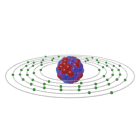
Bohr Model
Static
Interactive
Descriptive Numbers
CAS Number
7440-00-8
CID Number
CID23934
RTECS Number
RTECSQO8575000
Mendeleev Number
19
Pettifor Number
30
Space Group Number
194
Glawe Number
29
Mass
Atomic Mass
144.2423 Da
Uncertainty
0.003
Periodic Position
X Position
7
Y Position
8
Period
6
Group
N/A
Classification
Block
f
Category
Lanthanides
Geochemical
Rare Earth and Similars
Goldschmidt
Lithophilic
Electrical Type
Conductive
Abundance
Seawater
2.8e-12 kg/L
Sun
9e-7 mole ratio to silicon
Earth Crust
0.000042 g
Solar System
8.3e-7 mole ratio to silicon
Meteorites
0.00005 %
Color
Jmol
#C7FFC7
Molcas Gv
#C7FFC7
CPK
#FF1493
Atomic Radius
Empirical
185
Calculated
206
Van Der Waals
20
Rahm
284
Uff
357.5
Mm3
273
Alvarez
295
Covalent (Single Bound)
20
Covalent (Cordero)
201
Covalent (Pyykko)
174
Covalent (Pyykko Double)
137
Metallic
181.4
Temperature
Melting/Freeze (USE)
1297 °K
Melting/Freeze (WEL)
1297 °K
Melting/Freeze (CRC)
1294 °K
Melting/Freeze (LNG)
1297 °K
Boiling/Density (USE)
3347 °K
Boiling/Density (WEL)
3373 °K
Boiling/Density (CRC)
3347 °K
Boiling/Density (LNG)
3347 °K
Boiling/Density (Zhang)
3303 °K
Density
STP
7.01 kg/cm³
Solid (WEL)
6800 kg/cm³
Solid (CRC)
7010 kg/cm³
Solid (LNG)
7010 kg/cm³
Liquid (CR2)
6890 kg/cm³
Heat
Molar Volume
20.58 cm³/mol
Atomic Volume
20.6 cm³
Heat Of Fusion USE
7.1 kJ/mol
Heat Of Fusion CRC
7.14 kJ/mol
Heat Of Fusion LNG
7.14 kJ/mol
Heat Of Fusion WEL
7.1 kJ/mol
Evaporation USE
289 kJ/mol
Evaporation LNG
289 kJ/mol
Evaporation WEL
285 kJ/mol
Evaporation Zhang
289 kJ/mol
Molar Heat
27.45 J/molK
Heat Capacity USE
0.205 J/gK
Heat Capacity CRC
27.45 J/gK
Heat Capacity LNG
27.5 J/gK
Heat Capacity WEL
27.4 J/gK
Thermal Expansion
0.0000096 1/K
Adiabatic Index
N/A
Speed of Sound
Extensional
2330 m/s
Electrical Resistance
293k
643 nΩm
Magnetic Properties
Order
paramanyetic
Neel Point
19.2 Tn
Susceptibility
4.8e-7 m3/kg
Elasticity
Shear Modulus
16.3 GPa
Bulk Modulus
31.8 GPa
Poisson Ratio
0.281 ν
Youngs Modulus
41.4 GPa
Hardness
Brinell
265–700
Vickers
343–746
Etymology
Description
It is a soft, shiny, silvery metal element. It is found among the lanthanides. It has seven natural isotopes. Nd-144 is the only radioactive of these, with a half-life of 10^10-10^15 years. Six artificial radioisotopes have been produced. It is used to give the glass a violet purple color to make it two-colored in glassware. It is among the most reactive rare earth metals, reacting rapidly with air. It is used in some rare earth alloys. It is used to color neodymium welding glasses. It is also used in the construction of very strong permanent magnets (Nd2Fe14B). It was discovered in 1885 by Carl F. Auer von Welsbach by separating didymium into the elements praseodymium and neodymium. The name of the element comes from the Greek word "neos didymos" meaning "new twin". It should be noted that neodymium is extremely toxic, but findings indicate that it may only cause skin and eye irritation. However, it poses a risk of fire and explosion in powder form.
Language Of Origin
Greek
Origin Of Word
From the Greek phrase neos didymos, meaning "new twin"
Meaning
new twin
Symbol Origin
descriptive
Etymological Description
It comes from the Greek expression neos didymos, meaning "new twin". Didymium is divided into two types: praseodymium and neodymium. They have different colored salts that help distinguish them.
Discovery & Isolation
Observed/Predicted By
C. A. von Welsbach
Observed/Discovery Year
1885
Discovery Location

Production & Use
Sources
It is obtained by electrolysis of halide salts made from monanite sand.
Uses
It is used in lasers to make artificial rubies. It is also used in ceramics, luminous violet glass, special glasses that filter infrared radiation, and, together with praseodymium, in the production of a special lens. It constitutes 18% of Misch metal used in steel making.
Radioactivity
Half Life
Stable
Lifetime
Stable
Neutron Mass Absorption
0.011
Neutron Cross Section
49
Electron Affinity
Electron Affinity (eV)
1.916
Electron Affinity (kJ/mol)
184.87
Electron Affinity (pauling)
1.14
Electron Affinity (ghosh)
0.176539
Dipole Polarity
Accepted
208
Uncertainty
20
C6 GB
3560
Lattice
Constant Internal Default Radius
3.66
Constant
365.8, 365.8, 1179.9
Strucutre
HEX
Angles
π/2, π/2, 2 π/3
Electron & Quantum
Oxidation States
0,2,3,4
Electron Configuration
1s2 2s2 2p6 3s2 3p6 4s2 3d10 4p6 5s2 4d10 5p6 6s2 4f4
Quantum Number
5I4
Electron Configuration Semantic
[Car] 4f4 6s2
Shells-0
2
Shells-1
8
Shells-2
18
Shells-3
22
Shells-4
8
Shells-5
2
Ionization Energies-0
533.1
Ionization Energies-1
1040
Ionization Energies-2
2130
Ionization Energies-3
3900
List of Compounds
1-10 of 38 compounds
| Formula | Names |
|---|---|
| Nd | neodymium neodymium metal |
| NdBr3 | neodymium bromide neodymium bromideanhydrous neodymium tribromide tribromoneodymium |
| NdCl3 | neodymium chloride neodymium trichloride trichloroneodymium |
| F3Nd | neodymium fluoride neodymium(III) fluoride, anhydrous neodymium trifluoride trifluoroneodymium |
| I3Nd | neodymium iodide neodymium(III) iodide neodymium(III) iodide anhydrous neodymium iodide (nd I3) neodymium triiodide triiodoneodymium |
| NNd | neodymium nitride |
| NdB6 | neodymium boride |
| NdCl2 | neodymium(II) chloride |
| NdSb | neodymium antimonide antimony, compound with neodymium (1:1) |
| Nd2O3 | neodymium(III) oxide dineodymium trioxide neodymia neodymium oxide |