Basic Information
Name
Polonium
Atomic Number
84
Allotropes
Alpha Polonium, Beta Polonium
Appearance
Silvery
Phase At STP
Solid
Spectrum Image

Source
WikipediaBohr Model
Static
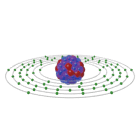
Interactive
Descriptive Numbers
CAS Number
7440-08-06
Mendeleev Number
103
Pettifor Number
91
Space Group Number
221
Glawe Number
93
Mass
Atomic Mass
209 Da
Periodic Position
X Position
16
Y Position
6
Period
6
Group
16
Classification
Block
p
Category
Post Transition Metal
Geochemical
U/Th decay series
Goldschmidt
Synthetic
Electrical Type
Conductive
Abundance
Seawater
1.5e-20 kg/L
Earth Crust
2e-16 g
Meteorites
N/A %
Color
Jmol
#AB5C00
Molcas Gv
#AB5C00
CPK
#FF1493
Atomic Radius
Empirical
190
Calculated
135
Van Der Waals
197
Rahm
250
Uff
470.9
Mm3
259
Truhlar
197
Covalent (Triple Bound)
129
Covalent (Cordero)
140
Covalent (Pyykko)
145
Covalent (Pyykko Double)
135
Covalent (Pyykko Triple)
129
Temperature
Melting/Freeze (USE)
527 °K
Melting/Freeze (WEL)
527 °K
Melting/Freeze (CRC)
527 °K
Melting/Freeze (LNG)
527 °K
Boiling/Density (USE)
1235 °K
Boiling/Density (WEL)
1235 °K
Boiling/Density (CRC)
1235 °K
Boiling/Density (LNG)
1235 °K
Density
STP
9.196 kg/cm³
Solid (WEL)
9196 kg/cm³
Solid (CRC)
9200 kg/cm³
Solid (LNG)
9196 kg/cm³
Heat
Molar Volume
22.97 cm³/mol
Atomic Volume
22.7 cm³
Heat Of Fusion USE
10 kJ/mol
Evaporation USE
102.9 kJ/mol
Molar Heat
26.4 J/molK
Heat Capacity USE
0.125 J/gK
Heat Capacity LNG
26.4 J/gK
Adiabatic Index
N/A
Electrical Resistance
273k
400 nΩm
Etymology
Description
It is a rare radioactive metal element in the 16th group of the periodic table. It has more than thirty known isotopes, the highest number of isotopes of all elements. Po-209 has a half-life of 103 years. It can be used for spacecraft heating. It was discovered in a uraninite sample by Marie Curie in 1898.
Language Of Origin
Latin
Origin Of Word
Named after Poland, the country of Marie Curie, who also discovered radium.
Meaning
Poland
Symbol Origin
place name
Etymological Description
It is named after Poland, the country of its discoverer, Marie Curie. It is also called Radium F.
Discovery & Isolation
Observed/Predicted By
Pierre ve Marie Curie
Discovery Location

Isolated Sample By
W. Marckwald
Isolated Sample Year
1902
Production & Use
Sources
It is found in uraninite after the decay of bismuth.
Uses
It is used in industrial equipment produced to prevent static electricity generated during processes such as paper, cable and sheet rolling.
Radioactivity
Half Life
102.1 years
Lifetime
147.1 years
Decay Mode
Alpha Six
Neutron Cross Section
0.5
Electron Affinity
Electron Affinity (eV)
1.9
Electron Affinity (kJ/mol)
136
Electron Affinity (pauling)
2
Electron Affinity (allen)
13
Electron Affinity (ghosh)
0.186842
Dipole Polarity
Accepted
44
Uncertainty
4
C6 GB
424
Lattice
Constant Internal Default Radius
3.35
Strucutre
SC
Angles
p/2, p/2, p/2
Electron & Quantum
Oxidation States
−2,2,4,5,6
Electron Configuration
1s2 2s2 2p6 3s2 3p6 4s2 3d10 4p6 5s2 4d10 5p6 6s2 4f14 5d10 6p4
Quantum Number
a burden
Electron Configuration Semantic
[Rook] 4f14 5d10 6s2 6p4
Shells-0
2
Shells-1
8
Shells-2
18
Shells-3
32
Shells-4
18
Shells-5
6
Ionization Energies-0
812.1
List of Compounds
1-3 of 3 compounds
| Formula | Names |
|---|---|
| Po | polonium polonium metal |
| Cl4Po | polonium(IV) chloride |
| PoO2 | polonium(IV) oxide |