21
Sc
Scandium
44.9559085
Basic Information
Bohr Model
Descriptive Numbers
Mass
Periodic Position
Classification
Abundance
Color
Atomic Radius
Temperature
Density
Heat
Electrical Resistance
Magnetic Properties
Elasticity
Hardness
Etymology
Discovery & Isolation
Production & Use
Radioactivity
Electron Affinity
Dipole Polarity
Lattice
Electron & Quantum
List of Compounds
Basic Information

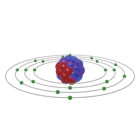
Bohr Model
Static
Interactive
Descriptive Numbers
CAS Number
7440-20-2
CID Number
CID23952
DOT Number
3089
Mendeleev Number
11
Pettifor Number
20
Space Group Number
194
Glawe Number
48
Mass
Atomic Mass
44.9559085 Da
Uncertainty
0.000005
Periodic Position
X Position
3
Y Position
4
Period
4
Group
3
Classification
Block
d
Category
Transition Metal
Geochemical
First Series Transition Metal
Goldschmidt
Lithophilic
Electrical Type
Conductive
Abundance
Urban Soil
0.0094 mg/kg
Seawater
6e-13 kg/L
Sun
0.000035 mole ratio to silicon
Earth Crust
0.000022 g
Solar System
0.000034 mole ratio to silicon
Meteorites
0.00064 %
Color
Jmol
#E6E6E6
Molcas Gv
#E6E6E6
CPK
#FF1493
Atomic Radius
Empirical
160
Calculated
184
Van Der Waals
211
Batsanov
230
Rahm
263
Uff
329.5
Mm3
261
Alvarez
258
Covalent (Single Bound)
144
Covalent (Triple Bound)
114
Covalent (Cordero)
170
Covalent (Pyykko)
148
Covalent (Pyykko Double)
116
Covalent (Pyykko Triple)
114
Mendeleev
144
C12
162
Metallic
162
Temperature
Melting/Freeze (USE)
1814 °K
Melting/Freeze (WEL)
1814 °K
Melting/Freeze (CRC)
1814 °K
Melting/Freeze (LNG)
1814 °K
Boiling/Density (USE)
3109 °K
Boiling/Density (WEL)
3103 °K
Boiling/Density (CRC)
3109 °K
Boiling/Density (LNG)
3109 °K
Boiling/Density (Zhang)
3003 °K
Superconducting Point
0.05 °K
Density
STP
2.985 kg/cm³
Solid (WEL)
2985 kg/cm³
Solid (CRC)
2990 kg/cm³
Solid (LNG)
2985 kg/cm³
Liquid (CR2)
2800 kg/cm³
Heat
Molar Volume
15 cm³/mol
Atomic Volume
15 cm³
Heat Of Fusion USE
15.8 kJ/mol
Heat Of Fusion CRC
14.1 kJ/mol
Heat Of Fusion LNG
14.1 kJ/mol
Heat Of Fusion WEL
16 kJ/mol
Evaporation USE
332.7 kJ/mol
Evaporation LNG
332.7 kJ/mol
Evaporation WEL
318 kJ/mol
Evaporation Zhang
310 kJ/mol
Molar Heat
25.52 J/molK
Heat Capacity USE
0.556 J/gK
Heat Capacity CRC
25.52 J/gK
Heat Capacity LNG
25.52 J/gK
Heat Capacity WEL
25.5 J/gK
Thermal Conductivity
15.8 W/m*K
Thermal Expansion
0.0000102 1/K
Adiabatic Index
N/A
Electrical Resistance
293k
562 nΩm
Magnetic Properties
Order
paramanyetic
Susceptibility
8.8e-8 m3/kg
Elasticity
Shear Modulus
29.1 GPa
Bulk Modulus
56.6 GPa
Poisson Ratio
0.279 ν
Youngs Modulus
74.4 GPa
Hardness
Brinell
736–1200
Etymology
Description
It is a rare soft silvery metal element that belongs to the third group in the periodic table. It has ten isotopes, with nine being radioactive and having short half-lives. It was predicted by Mendeleyev in 1869 and isolated by Nilson in 1879.
Language Of Origin
Latin
Origin Of Word
From the Latin word Scandia, which means Scandinavia
Meaning
Scandinavia
Symbol Origin
place name
Etymological Description
It comes from the Latin Scandia, meaning Scandinavia. It was formerly known as eka-boron.
Discovery & Isolation
Observed/Predicted By
F. Nilson
Observed/Discovery Year
1879
Discovery Location

Isolated Sample By
F. Nilson
Isolated Sample Year
1879
Production & Use
Sources
It is mostly found in tortveitite (containing approximately 34% scandium) and wiikite minerals. It is also found in tin and tungsten ores. Pure scandium is obtained as a byproduct of uranium refining.
Uses
Scandium metal is used in aviation, scandium oxide (Sc2O3) is used in the production of high-intensity electric lamps, and scandium iodide (ScI3) is used in the production of lamps that give a light tone very close to sunlight.
Radioactivity
Half Life
Stable
Lifetime
Stable
Neutron Mass Absorption
0.025
Neutron Cross Section
27.2
Electron Affinity
Proton Affinity
914
Electron Affinity (eV)
0.188
Electron Affinity (kJ/mol)
18
Electron Affinity (pauling)
1.36
Electron Affinity (allen)
7.042
Electron Affinity (ghosh)
0.1193833
Dipole Polarity
Accepted
97
Uncertainty
10
C6 GB
1570
C6 Coefficient
1383
Lattice
Constant Internal Default Radius
3.31
Constant
330.9, 330.9, 527.33
Strucutre
HEX
Angles
π/2, π/2, 2 π/3
Electron & Quantum
Oxidation States
0,1,2,3
Electron Configuration
1s2 2s2 2p6 3s2 3p6 4s2 3d1
Quantum Number
I put/a
Electron Configuration Semantic
[Ar] 3d1 4s2
Shells-0
2
Shells-1
8
Shells-2
9
Shells-3
2
Ionization Energies-0
633.1
Ionization Energies-1
1235
Ionization Energies-2
2388.6
Ionization Energies-3
7090.6
Ionization Energies-4
8843
Ionization Energies-5
10679
Ionization Energies-6
13310
Ionization Energies-7
15250
Ionization Energies-8
17370
Ionization Energies-9
21726
Ionization Energies-10
24102
Ionization Energies-11
66320
Ionization Energies-12
73010
Ionization Energies-13
80160
Ionization Energies-14
89490
Ionization Energies-15
97400
Ionization Energies-16
105600
Ionization Energies-17
117000
Ionization Energies-18
124270
Ionization Energies-19
547530
Ionization Energies-20
582163
List of Compounds
1-10 of 28 compounds
| Formula | Names |
|---|---|
| Sc | scandium scandium metal |
| ScCl3 | scandium chloride scandium(3+) chloride scandium trichloride trichloroscandium |
| ScF3 | scandium fluoride scandium fluoride REO whitepowder scandium trifluoride trifluoroscandium |
| ScI3 | scandium(III)iodide triiodoscandium |
| Sc2O3 | scandium(III) oxide scandiascandium oxide |
| ScSb | scandium antimonide antimony, compound with scandium (1:1) |
| ScB2 | scandium boride |
| Sc2Te3 | scandium telluride |
| Sc(C5H5)3 | tris(cyclopentadienyl)scandium(III) cyclopentane; scandium |
| C27H39Sc | tris(butylcyclopentadienyl)scandium(III) butylcyclopentane; cyclopentane; scandium |